
Fenna had learned to tell time without a clock.
Morning arrived with a thin, grey light stretching across the waste ground and the first lorries rumbling in. Noon came when the heat pressed down so heavily that the air itself seemed to wilt. And evening… evening came when a familiar tightness began to curl behind her ribs—not from running or lifting, but from hunger.
She was eight years old, small and nimble, navigating the dump as if it were a map only she could read.
She knew which piles were fresh from the warmth of the rubbish. She knew which men to avoid by the shiftiness in their eyes. Some searched for scrap metal. Others searched for people.
Those were the dangerous ones.
That morning, she worked quickly, weaving between shards of glass and rusted steel, her fingers sorting through plastic and wiring with practised speed. She had already found two bottles and a crumpled piece of aluminium—enough for a small loaf of bread if she was lucky.
Then she heard it.
A sound that did not belong.
It was faint. Weak. Like someone trying to breathe through something tight and stifling.
Fenna froze.
The dump was never silent—machines roared, dogs barked, people shouted—but this sound pierced through all of it. It wasn’t noise.
It was life.
And it was frightened.
Slowly, cautiously, she followed it. Around a pile of broken furniture. Past a stack of old doors and cupboards. Until she found it.
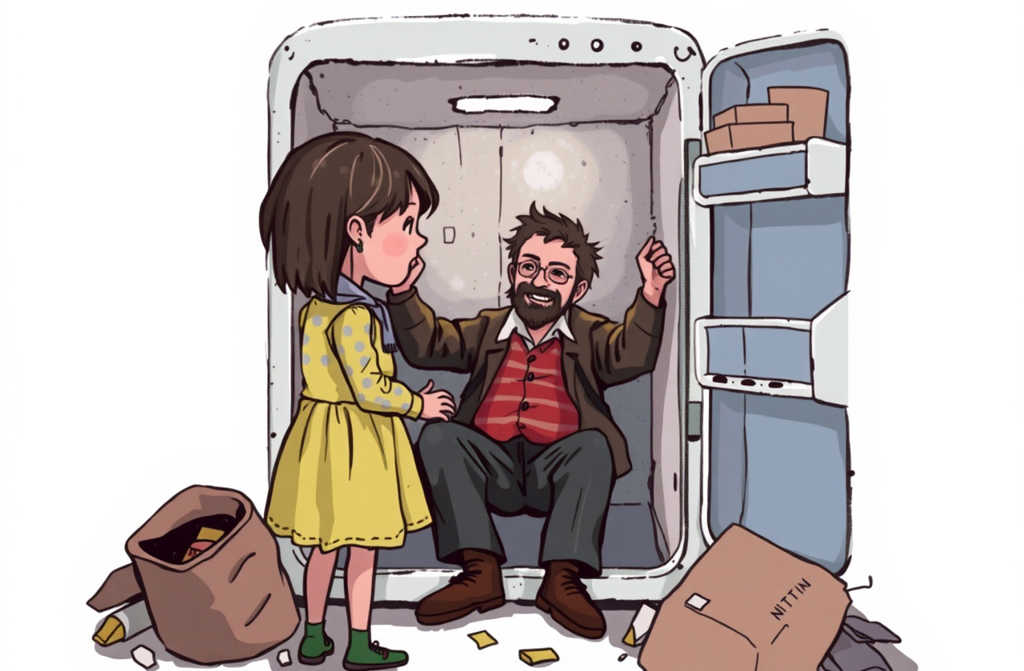
A discarded refrigerator, tipped on its side.
It was tied shut with thick rope.
The sound came from inside.
Fenna’s heart began to hammer.
Curiosity could get you hurt. That was the first rule she had learned. But something about that sound—desperate, fragile—drew her closer.
She crouched near the fridge and pressed her eye to a narrow crack.
Inside, something shifted.
Then she saw it.
An eye.
Red. Swollen. Barely open.
A man.
Not like the other men she saw in the dump. His clothes—though torn and filthy—had once been expensive. His face was bruised, his lips parched.
“Alsjeblieft…” he whispered, his voice barely audible. “Water…”
Fenna stepped back on instinct.
Her body remembered things her mind tried to forget—grabbing hands, false promises, shelters that were not safe. Men were rarely harmless.
“Wie ben jij?” she asked, keeping her distance.
The man swallowed with visible pain. “Jasper… Jasper de Wit.”
The name meant nothing to her.
But his voice… it sounded as though it might vanish at any moment.
“Alsjeblieft,” he said again. “Ik zit hier… al te lang.”
Fenna looked around.
No one was nearby.
The men collecting metal were far down the slope. A lorry was unloading on the other side. The dogs were busy fighting over scraps.
She looked back at the rope.
Whoever had tied it had intended for him to stay inside.
That made her chest feel tight.
“Niet bewegen,” she said.
The man let out a weak, almost broken laugh. “Dat zal wel lukken.”
Fenna ran.
Her bare feet flew over dirt and rubble as she rushed to the edge of the dump, where an older woman named Maaike ran a small food stall. Fenna had no money, but she knew where Maaike kept a bucket of water.
She grabbed a chipped plastic cup and dipped it in.
“Hé!” Maaike shouted. “Wat doe jij nu?”
“Er is een man!” Fenna cried. “Hij zit vast—in een koelkast!”
Maaike stared in disbelief.
But Fenna didn’t wait.
She ran back.
When she returned, the man’s breathing was more ragged. She carefully tipped the water through the gap. Most of it spilled, but a little reached his mouth.
He closed his eyes as if it were the finest thing he had ever tasted.
“Dank je,” he whispered.
Fenna grabbed a sharp piece of metal nearby and began sawing at the rope.
Her hands trembled. The rope was thick. Her fingers burned.
“Waarom zit u hier?” she asked.
There was a pause.
“Ik denk… dat iemand mij wilde laten verdwijnen,” Jasper said softly.
Fenna nodded. She wasn’t surprised. “Dat gebeurt hier vaker.”
After several minutes, the rope finally snapped.
She pulled the fridge door open.
A wave of heat and stale air rushed out.
Jasper half-fell out, gasping, his body weak and trembling.
Up close, he looked worse—bruised, drained, but alive.
He noticed her staring and slowly slid a silver watch from his wrist.
“Neem maar,” he said.
She didn’t move.
“Voor het helpen.”
Fenna shook her head. “Iemand zou hem van me afpakken. Of mij ervoor pijn doen.”
Jasper looked at her for a long moment, then lowered his hand.
“Juist,” he said softly.
That was when Maaike arrived, with two men and a teenage boy pushing a cart.
“Waar in hemelsnaam—” Maaike gasped.
They helped Jasper into a van and rushed him to a nearby clinic.
Fenna climbed into the back without asking.
She sat beside him the whole way, holding the cup of water.
At the clinic, everything shifted.
Jasper made one phone call.
“Ik leef,” he said.
Less than an hour later, black cars filled the courtyard.
Well-dressed people hurried inside.
A woman with silver-grey hair—his aunt—embraced him as if she had been holding her breath for days.
Only then did Fenna learn the truth.
Jasper de Wit wasn’t just a man.
He was a multimillionaire.
Someone influential enough to have enemies.
Someone who had nearly vanished forever.
And someone who had been saved… by a girl nobody noticed.
Later, Jasper asked to see her.
Fenna stepped into the clean, quiet room, unsure where to stand.
He smiled when he saw her.
“Je bent gebleven,” he said.
“Ik heb alleen maar de deur opengemaakt,” she replied.
He shook his head gently. “Nee. Jij hebt ervoor gekozen om niet door te lopen.”
She didn’t answer.
His aunt stepped forward. “Waar is jouw familie?”
“Er is niemand,” Fenna said simply.
“En wie zorgt er voor jou?”
“Niemand.”
A silence fell over the room.
Jasper looked at her intently.
“Dat houdt nu op,” he said.
Her eyes narrowed. “Waarom?”
“Omdat er allang iemand voor jou had moeten zijn.”
She didn’t trust easy words.
But his voice… it didn’t sound like a promise. It sounded like a decision.
“Je hoeft vandaag nog niet ja te zeggen,” his aunt added softly. “Je mag er de tijd voor nemen.”
For the first time in her life, Fenna realised something peculiar.
She had a choice.
In the weeks that followed, everything moved slowly—but steadily.
The truth about Jasper’s attack came out. A business partner had tried to get rid of him for good.
But Jasper recovered.
And he kept coming back to visit Fenna.
Not with expensive gifts.
With fruit. Books. Questions.
“Wat vind je leuk?”
“Wil je leren?”
“Heb je ooit een verjaardag gevierd?”
At first, she answered in single words.
Then in sentences.
Then in small stories.
Months later, Fenna moved into a small guest house on his aunt’s estate.
Not a mansion.
A home.
She started school.
It was difficult.
She couldn’t really read yet. Other children stared. Some whispered.
But she didn’t run.
And every afternoon, Jasper helped her with her homework.
“Waarom geeft u hier zoveel om?” she asked him once.
He smiled. “Omdat het meisje dat mijn leven redde een toekomst verdient.”
A year later, Fenna stood on a stage at school, receiving an award.
Her hair was neatly tied. Her dress was clean. Her hands no longer shook.
When Jasper was invited to speak, he didn’t talk about success or money.
He looked at her.
“Mijn leven veranderde,” he said, “omdat iemand die de wereld negeerde voor vriendelijkheid koos.”
Not long after, construction began at the edge of the dump.
A community centre.
Jobs. Food. Education. Safety.
A second chance.
On opening day, Fenna stood with Maaike, Jasper, and a crowd of families.
Above the entrance were the words she had chosen:
Niemand wordt hier vergeten.
Jasper handed her a pair of scissors.
“Ben je er klaar voor?” he asked.
Fenna looked at the crowd.
At the place she had once called home.
At the life she had almost never escaped.
Then she smiled.
And cut the ribbon.
The applause rose around her like morning light.
And for the first time in her life…
The ache in her chest wasn’t hunger.
It was hope. Want het grootste verschil maken vaak de kleinste handen.
Powiązane wpisy:
 Małe, przerażone dziecko i najbogatszy mężczyzna. Jego słowa na straży domu odkryły tajemnicę, która zniszczyła potężny ród.5 min czytania.
 Dotknij mnie jeszcze raz, a pożałujesz… Myślał, że poniża nieznajomą, aż cała baza oddała jej honory.4 min czytania.
 Ostatnie życzenie umierającej matki. To, co usłyszała od córki, zmieniło wszystko.6 min czytania.
 Tajemnica w Oczach Dziedziczki Fortuny Ale zanim zdążyła ostrzec rodzinę, światła w wielkim domu zgasły na zawsze.5 min czytania.